

Catalogues of flat stations and heat substations


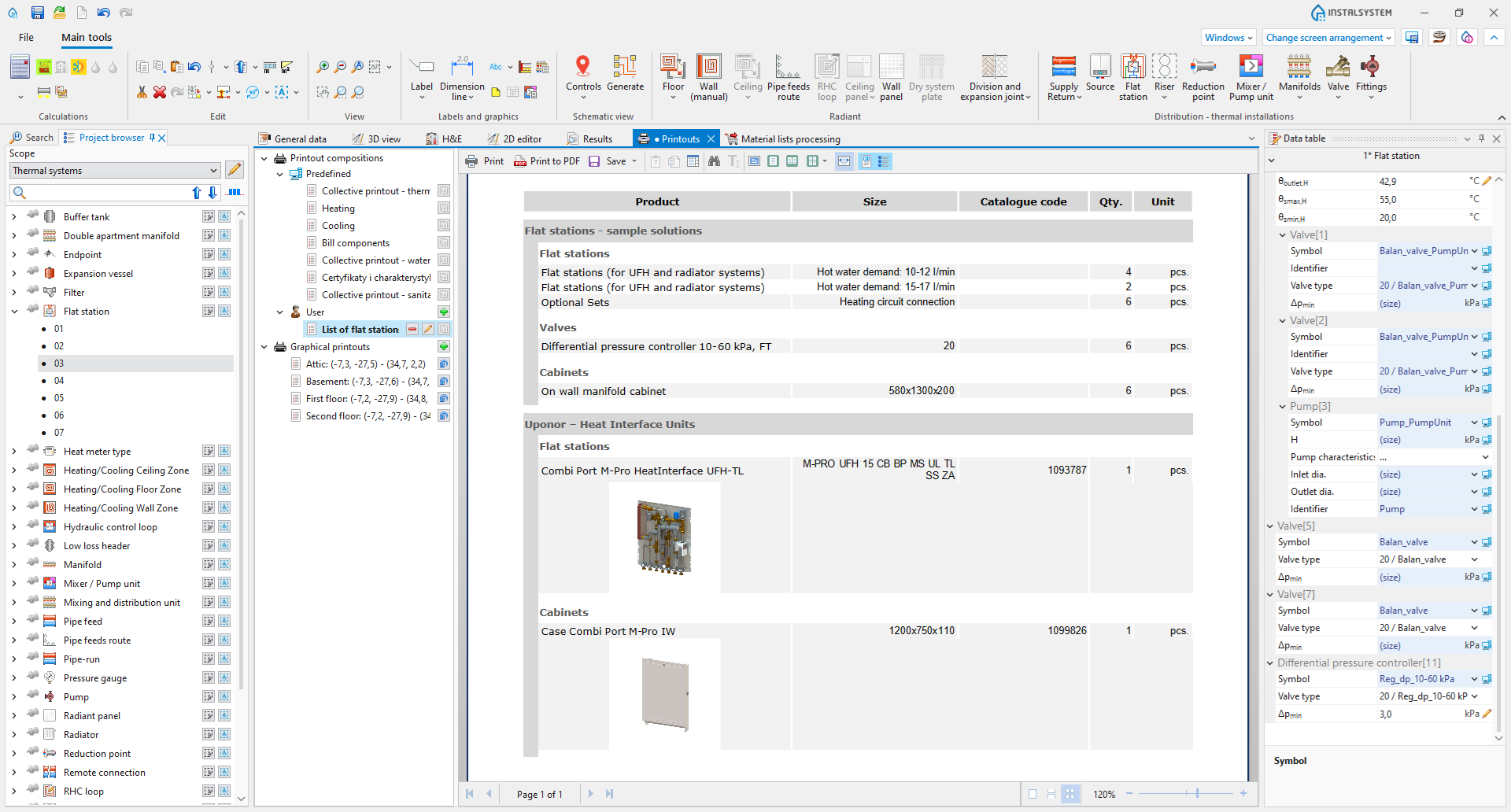
Flat stations/residential heat substations are devices that are most often installed in close proximity to heating risers and whose primary function is to heat domestic hot water. In addition, they also most often mediate the supply of heating medium to the residential heating system. The flat station, in addition to basic elements such as a heat exchanger and a 3-way controller (the so-called PM-regler), contains a number of additional obligatory or optional accessories, which allow balancing, regulation of factor parameters and metering of heating, as well as hot and cold domestic water flows. The InstalSystem package includes both company catalogues, i.e. a specific producer, and a neutral catalogue.
The range of product types that can be included in the catalogue

Different types of flat stations based on different schemes can be placed in the cataloque. In general this are:

  • Flat stations for preparing hot water and supplying the residential system with heating medium:
    • supplying only the radiator system,
    • supplying only the underfloor heating system,
    • supplying both the radiator system and the underfloor heating system.
  • Stations for preparation of hot water only.

Possible additional equipment (as an obligatory or optional accessory):

  • pressure differential controller before the tap water heat exchanger,
  • pressure differential controller before residential heating installation,
  • balancing valve in the radiator secondary circuit,
  • additional heat exchanger separating the residential heating circuit (secondary) from the supply circuit (primary),
  • heat meter,
  • filter on the central heating/strainer,
  • shut-off/ball valves,
  • pressure gauge, thermometer,
  • cabinet,
  • mixer,
  • manifold,
  • dehydration kit.

In some cases, information on whether a particular type of flat station can be included in the program’s cataloques requires prior analysis in terms of the type and arrangement of the elements included in the flat station.
At the moment, only elements with one heat exchanger are supported in the program.

The range of data used

  • Products’ names and catalog codes,
  • Products’ pictures and short notice “About the company” information,
  • Technical data:
    • Types and design variants with catalog codes,
    • Dimensions of the station,
    • Station’s scheme with components’ localization and information which one is mandatory and which one is optional,
    • Technical data and hydraulic parameters of components:
      • Working parameters of the station:
        • Maximum operating pressure,
        • Minimum and maximum temperature on supply side,
        • (opc.) Minimum and maximum output of the hot water exchanger,
        • Maximum hot water outflow,
        • Maximum flow rate on a primary (supply) side of heat exchanger
      • Thermal characteristics of the hot water exchanger. (required flow on the primary circuit (kg/h or l/h) as a function of supply temperature (°C), hot water outflow. (l/min) and required heating. (K)),
      • Hydraulic characteristics of the hot water exchanger (pressure loss (bar or kPa) as a function of flow on the central heating side (l/h) and hot water side (l/min)),
      • Characteristics of the return temperature of the heating medium as a function of the temperature of the exchanger medium (°C) and the output flow of hot water. (l/min),
      • Hydraulic parameters of the elements on the primary and secondary side of the heating medium circuit,
      • Hydraulic parameters of elements on the drinking water side,
  • Number, arrangement and diameters (threads) of connection points,
  • Information on matching cabinets and their dimensions.

InstalSystem 5 modules using catalogues

stacje mieszkaniowe
flat stations

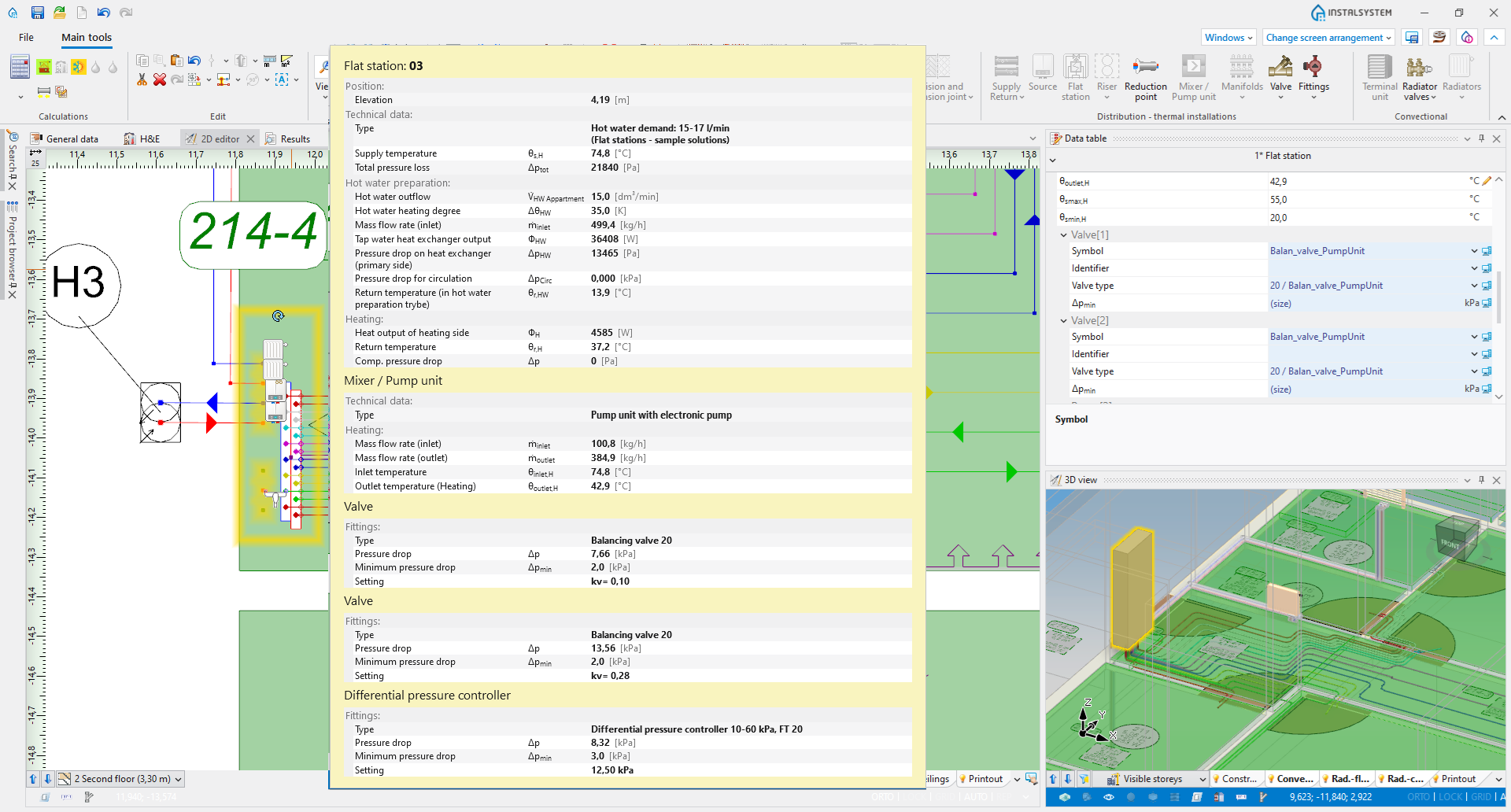
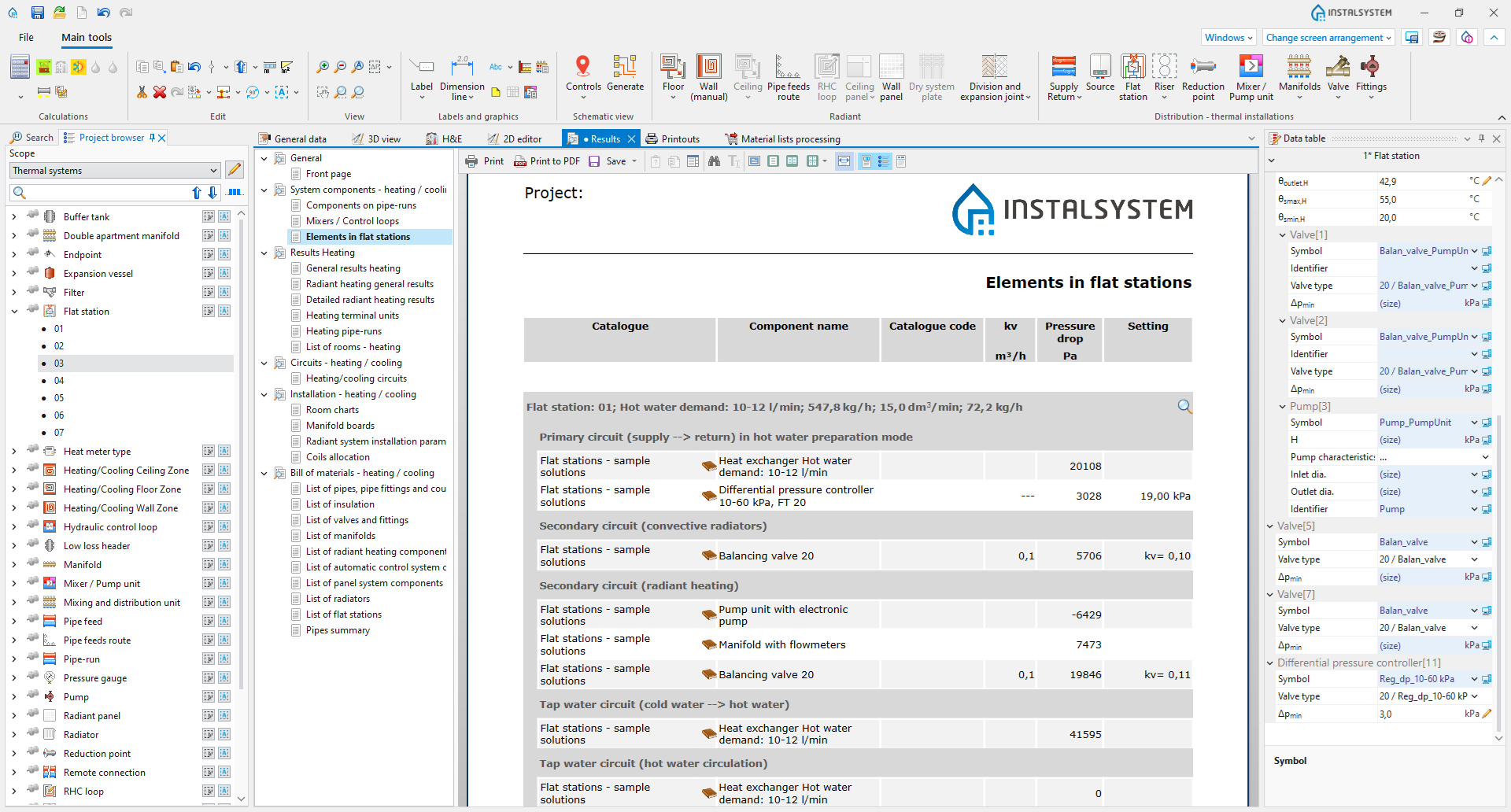
The module allows to use flat stations within the building’s technical infrastructure. Flat stations are represented in the program by a single-unit system element with precisely defined system connection points and with the possibility to customize its sub-elements and accessories.

  • Use of flat stations in designs:
    • Preparation (heating) of domestic hot water by an installed plate heat exchanger
    • Distribution of the medium in the flat heating (convective and radiant) system
  • Chosen essential functionalities realised by the module:
    • Sizing of the installation feeding the stations
    • Diagnostics of the necessary domestic hot water exchanger to obtain required outflow and heating of the domestic water with defined temperature of feeding the station with heating medium (exchanger dimensions are chosen manually by the user)
    • Calculation of required supply system output which feeds the flat system installation
  • Additional functions available for the Kamo stations:
    • Calculations and presentation of the required buffer recipient capacity in the installation feeding flat stations according to the original KAMO methodology
systemy grzewcze
heating systems

The module provides the possibility of designing any heating system, including network and fitting sizing and hydronic balancing. Any kind of heating terminal (including fan-coils) is simulated by a ‘Receptor with known hydraulic resistance’. Together with the ‘Radiator sizing’ module, convective radiator systems can be designed. Together with the ‘Radiant systems’ module, the following radiant systems can be designed: floors (including those with return temperature limiter), walls, ceilings. In combination with the ‘Panel systems’ module, modular panel systems can be designed. In projects with a common heat source for both convective and radiant systems, it is possible to use mixers or pump-mixing sets to obtain temperatures appropriate for radiant systems.

systemy plaszczyznowe
radiant systems
instalacje wodociagowe
tap water systems

The module provides the ability to design water supply systems (hot and cold water, hot water circulation network). Includes graphical editing in the project, pipes and fittings sizing, 2D and 3D drawing presentation, hydraulic calculations, bill of materials. Sanitary accessories can be associated with water draw-off points, which results in a complete installation model together with sanitary equipment of the rooms.

When creating a project, a 3D model is created, which preview can be used to check compliance with the expected state. Model visualization may include installations designed (or designed) in other modules of the InstalSystem 5 package.

Hot and cold water residential installations can form rings (configuration extension required with the ‘Tap water extensions’ module). It is possible to use “Flat station” elements as water heaters (configuration extension with the ‘Flat stations’ module required).

The module allows to use flat stations within the building’s technical infrastructure. Flat stations are represented in the program by a single-unit system element with precisely defined system connection points and with the possibility to customize its sub-elements and accessories.

  • Use of flat stations in designs:
    • Preparation (heating) of domestic hot water by an installed plate heat exchanger
    • Distribution of the medium in the flat heating (convective and radiant) system
  • Chosen essential functionalities realised by the module:
    • Sizing of the installation feeding the stations
    • Diagnostics of the necessary domestic hot water exchanger to obtain required outflow and heating of the domestic water with defined temperature of feeding the station with heating medium (exchanger dimensions are chosen manually by the user)
    • Calculation of required supply system output which feeds the flat system installation
  • Additional functions available for the Kamo stations:
    • Calculations and presentation of the required buffer recipient capacity in the installation feeding flat stations according to the original KAMO methodology

The module provides the possibility of designing any heating system, including network and fitting sizing and hydronic balancing. Any kind of heating terminal (including fan-coils) is simulated by a ‘Receptor with known hydraulic resistance’. Together with the ‘Radiator sizing’ module, convective radiator systems can be designed. Together with the ‘Radiant systems’ module, the following radiant systems can be designed: floors (including those with return temperature limiter), walls, ceilings. In combination with the ‘Panel systems’ module, modular panel systems can be designed. In projects with a common heat source for both convective and radiant systems, it is possible to use mixers or pump-mixing sets to obtain temperatures appropriate for radiant systems.

The module provides the ability to design water supply systems (hot and cold water, hot water circulation network). Includes graphical editing in the project, pipes and fittings sizing, 2D and 3D drawing presentation, hydraulic calculations, bill of materials. Sanitary accessories can be associated with water draw-off points, which results in a complete installation model together with sanitary equipment of the rooms.

When creating a project, a 3D model is created, which preview can be used to check compliance with the expected state. Model visualization may include installations designed (or designed) in other modules of the InstalSystem 5 package.

Hot and cold water residential installations can form rings (configuration extension required with the ‘Tap water extensions’ module). It is possible to use “Flat station” elements as water heaters (configuration extension with the ‘Flat stations’ module required).

Do you want to put your products in leading MEP & HVAC software?

Contact our sales department!

Contact